Tuesday, June 4, 2013

Design - 3


  • Battery charger controller
The DC voltage coming out from the panels must be higher than the DC voltage of the batteries, so that panels will have more emf than the batteries to push the charges through them. But if our typical 18 V DC panels are connected directly to the batteries, they will eventually overcharge and will cause severe damage to the batteries. Therefore I need a device to control the charges going into the battery bank to prevent overcharging. The charger is required to be three stage charge cycle controller. That means the batteries when they are under a certain voltage are charged applying bulk voltage and the battery draws the maximum current, then absorption voltage is applied and the current gradually decreases as the battery is being charged, then floating voltage is applied.

There are two type of solar battery charge controllers; PWM and MTTP.

  • PWM charge controllers
These are the cheaper ones which uses a duty cycle (on time/off time) to regulate the voltage from the panels to the battery bank

  • MTTP charge controllers
These are more expensive but usually gives 30% more power than PWM. They reduce the voltage coming out of the panels to reach that of the battery so that maximum current draw is possible

The charger is rated by input voltage (12 V DC in our case) and max current that it can handle ( we have 7 panels each 100 Watts, therefore 700 / 12 = 58.3 Amperes). We must be ready for some phenomena like edge of cloud effect or very bright circumstances, so I will calculate a 30% spare capacity. 58.3 x 1.3 = 75.8 Amperes.
In this case I need either one 80 A charge controller or two 40 A charge controllers wired in parallel.
Another option is raise the voltage to 24 V DC and use only one charge controller of 40 A.

Sunday, June 2, 2013

Design - 2


Types of solar energy systems
  • 1. Grid-Tie
In this system, the DC power comes out of the solar panels directly to the inverter (grid-tie inverter). This type of inverters convert the DC power to AC power and plugged directly in the mains and it synchronizes its wave form with that of the grid. It supplies your home with its nominal power (e.g. 500 Watts). If you are using more than 500 Watts than the rest is fed to your home from the grid. if you are not using all the 500 Watts, then you are feeding the grid itself. Your utility meter runs in backward direction. This happens as long as the sun shines, but after the sun sets, you are using the grid power only. Another feature in that inverter is when the grid power cuts off, the inverter power cuts off also. this is to prevent the inverter to feed the grid while workers are working and assuming no power is in the lines.

  • 2. Grid-Tie with batteries
This is like the grid-tie system, but there are backup batteries that are charged using the charger inside the inverter and are used mainly to feed your DC loads, or can be connected to another (not a grid-tie) inverter to feed some AC loads


  • 3. Off-Grid
In this system, the panels feed DC power to a battery charger which is connected to the battery bank to charge it while the sun is shining. An off-grid inverter is connected to the batteries to use their stored power to convert it to AC and feed AC loads. This type of inverters con not be plugged into the mains.


Components of solar energy system
  • Solar Panels
The sun sends in one hour an amount of energy enough for human consumption for a full year. We need to collect that energy and make use of it either directly or indirectly. Solar panel is one way to do so. Solar cells which form solar panels are like a transistor. They are made from high purity silicon that has impurities to form a P-N junction.A P-N junction that has positive and negative charges on the barrier of that junction. These charges are waiting for excitation to move around forming electrical current. The excitation comes from the power of the sun in the form of photons.
There exists 3 commercial types of solar cells; mono-crystalline, poly-crystalline and amorphous.
The mono-crystalline are the most efficient and also most expensive. Efficiency 17-20%
The poly-crystalline are the mid-range in terms of efficiency and price. Efficiency 12%
The amorphous are the least efficient and least expensive. Efficiency 8%

More efficient cells means that they collect more solar energy in the same area. Amorphous has an advantage that they are like a thin film and can be put on any shape without breaking and they can resist heat, but also they are very inefficient, lose efficiency by time and I will need more space to mount them.

I found that the most suitable type is the poly-crystalline in terms of performance and price.

As I said before that the average price of a mono-crystalline panel of 100 Watts is about 200$, so if I used a poly-crystalline panel it will cost me less. A more better idea that I can buy single solar cells and wire them together and put them into a frame to compose my custom solar panel which will save me some money.

If I'm going to power my requirements of 575 Wh directly from the solar panels (without using batteries) then I will have to get a 575 Watts panels. Calculating losses for inverter of 20% : 575 x 1.2 then I require panels power of  690 Watts panels. This will enable me to extract electricity only during sunlight hours.

  • Wiring solar cells
A solar cell of size 6" x 6" gives a typical of 0.5 V DC and 8 Amperes max (that equals 4 Watt). A solar panel gives a typical of 18 V DC. Then wiring 36 solar cell in series gives me that volt and keeping the current a 8 Amperes. This panel gives a maximum of 18 x 8 = 144 Watts. Therefore, I will need 900 / 144 = 7 panels of those. Wiring the panels together in parallel give me 18 V DC, 8 x 7 = 56 Amperes. That is equal to 56 Ah.
The solar cell has two sides, one is the negative (shiny side), and the one which is positive (matt). Wiring the positive side of  the cell to the next cell's negative side in series forms a panel. I can choose to either arrange than as 6 x 6 cells or as 4 x 9 cells. the latter will be better to save space.
I will the cells together under a protective surface such as glass or thick acrylic and over another piece of acrylic and insulate them to protect them from weather harshness like rain and dust. I will also put that setup inside an aluminium frame and fix them to another aluminium setup on the roof (my roof is horizontal, so I need to tilt them).

  • Mounting solar panels
To get the maximum efficiency I can from solar panels, I must mount them either on an adjustable base or on a fixed base. Adjustable base moves through the day using servo motors and a tilting controller that calculates the position of the sun to direct the panels towards it to collect as much power from the sun as it can. this systems cost too much and I'm not going to use them in my system.
Putting panels on a fixed base requires calculating horizontal and vertical angles. Because Egypt is in the northern hemisphere, then my panels should be directed towards the South. Cairo lies geographically in the latitude line number 30. As a general rule, in the winter when sun is far on the South, the panels needs a tilting angle of (Latitude + 15 = 45) and in summer where the sun is over our heads (Latitude - 15 = 15). I have to make my base adjustable with two positions to change them once every 6 months to get the max power from the sun.

Design - 1

I had to switch my goal for the reason of a low budget that I have, so I decided to power only one room in my apartment using solar energy. My goal is to have sustained power feeding to this room from the sun with the possibility to use it partially with the grid.

  • Before converting to solar energy
Being an automation engineer, and through my 9 working years, I gained a parameter in my personality which is "passion for efficiency and optimization". I make electrical designs and programs for machines and factory processes which are not tolerant to mistakes. These programs must run the equipment efficiently to save power and to output maximum production rate.
That made me always check the power consumption for the home appliances before buying. So I changed most of my 40 Watt incandescent light bulbs to  26 Watt and 35 Watt CFL bulbs. LED bulbs are yet better, and I intend to use them soon.
I also changed my CRT TV to an LCD 23" TV which was adequate for my small living room and for the price at the purchasing time.
Also trading my CRT 17" PC monitor for a LCD 19" one, these actions saved my a few EGP every month.
What I benefit from using energy efficient appliances is that I can use a bigger solar energy system with my available budget aside from saving me a little cash in the previous three years.

Note: when buying electrical appliances, look for the energy consumption grade. A grade is the better.


  • Basic load calculations
To decide how much power my living room requires, I must calculate the power drawn by every piece of electrical equipment in that room. I need to know the total power in terms of watt hours to size my solar energy system.

I have the following appliances:
  1. 23" LCD TV that draws 50 Watts
  2. A dish receiver that draws 25 Watts
  3. A fan that draws 137 Watts
  4. A CFL lamp that draws 35 Watts
  5. A flourescent lamp that draws 38 Watts
  6. A computer with power supply which draws 1 A = 1 x 220 V AC = 220 Watts
  7. A computer LCD monitor that draws 45 Watts
  8. Computer speakers that draws 25 Watts
That will result in a total power of  575 Watts. That is the power drawn by these devices when they are all on for one hour. Therefore I need 575 Watt/Hour (that is different from my previous calculation of 1.6 kWh, and that makes sense because it is about one third of my total power consumption and it's in the living room where me and my family stay most of the time. Aside from that, the fridge, microwave, washing machine, water heater, lighting and air condition consumes the rest)
Every device will be used for a certain hours per day, so let's calculate.

  1. 23" LCD TV is on for 6 hours
  2. Dish receiver is obviously on for the same 6 hours
  3. Fan will be on for 10 hours
  4. CFL lamp will be on for 6 hours
  5. Flourescent lamp will be discarded
  6. Computer+monitor+speakers will be on for 4 hours
The calculation will be: 50x6 + 25x6 + 137x10 + 35x6 + 290x4 = 300 + 150 + 1370 + 210 + 1160 = 3.2 kWh/day. I need a system that can supply that power and recharges itself from the sun for free.

What are the components of solar energy system?

To be continued...

Saturday, June 1, 2013

Study - 4

  • Market research
It was not convincing for me to pay that much for only 2-3 Hrs of power usage per week. So I took two decisions, the first is that I chose solar energy to rely on for reaching my goal. The second is I changed my goal.
Living in a dream of free power supply forever, without cutoffs within a small money resources is not just a
dream, it's a fantasy. Solar energy cost per kWh has gone down through the past few years, but still not good enough for mid-range people in a third-world country like Egypt.
Prices have gone from 11$ per kWh in 1998 to 4$ per kWh in 2012. That is about 77 EGP at 1998 to 28 EGP per kWh in 2012.
Comparing this to the grid electricity of 19 Pt / kWh, solar energy cost is 147 times that of the grid cost.
If taking into consideration that solar energy provides free power, and needs maintenance of  8000 EGP every 5 years (average battery life), therefore the running cost per month for using solar energy is 8000 / 5 = 1600 EGP per year equals 133 EGP per month. That's double the grid electricity costs. But take into consideration that the fossil fuel energy resources are limited, and electricity costs will not stop increasing. Also the power cutoff problem in Egypt is not anywhere near to be solved. So I think solar energy is not yet ready to be used in a wide scale in Egypt, but in the near future it will be.
Many people say that the investment in a good solar energy system starts paying for itself after 10 years, and I think it is true.


  • Who is the target of solar energy systems?
Paying a big sum of money for an investment which will return benefit after 10 years is not for regular citizens in Egypt. A person who decides to use solar power must have a good motive to justify his choice. For people living in Sinai (Eastern Egypt), Alwahat (Western Egypt) and Upper Egypt (Southern Egypt), the grid electricity supply is very difficult to be found in most places, so they live off-grid. They usually use diesel generators to power their houses. Many other places have limited hours of electrical supply per day. Those people are the most who are in need for solar energy, yet they don't usually have the sufficient financial resources. Also persons who have villas, chalets or weekend houses who also power them using diesel generators are in need for solar energy systems.

Note: I'm not mentioning industrial solar energy usage here. For instance, all communications equipment that are far from the grid are either solar or diesel powered. Diesel powered equipment needs a constant refill, but solar needs nothing.

There can be at least three ways to use solar energy:
  1. Off-grid: That is when I rely on solar power totally without the need for power from the grid.
  2. Grid-tie: That is when I rely on solar power and grid power both.
  3. Hybrid: That is when I use the two previous ways together.
I intend in my research to focus on people who have frequent power cutoffs and intend to use the solar system as a UPS only (those people are my case), and not totally rely on it.
I also had to do my calculations to find that I will dedicate a budget of 8,000 EGP for my system. I'm curious what can I achieve from that relatively small sum of money in terms of my requirements.

Study - 3


  • 2. Investment and value for money (continued)
SOLAR ENERGY

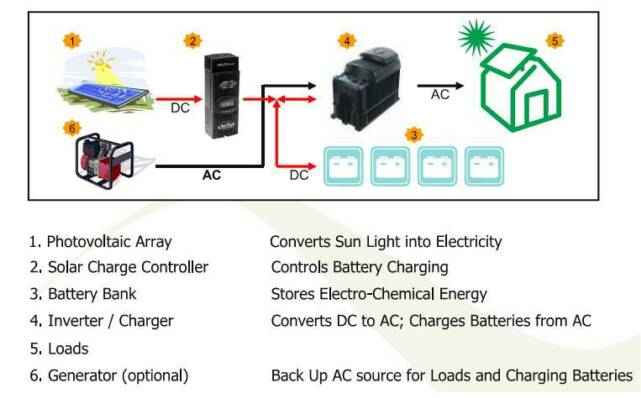
A typical solar energy system components are:
  1. Solar panels to harvest the sun's energy and change it to power.
  2. Solar charger/controller to regulate the rate of charging for batteries and prevent overcharging.
  3. A battery bank to store harvested energy.
  4. An inverter to convert DC voltage to AC voltage for powering the home appliances.
As for the UPS, I will need the same battery bank, but what about the other components?
I have to choose solar panels with enough current to charge my battery bank as fast as possible. If I have a typical solar panel of 100 Watt and output voltage of 18 V DC, then the current output is about 5.5 Amperes. Charging 400 Ah batteries from 5.5 A solar panels requires 73 hours (if I assume that I will not discharge the batteries more than 50%, then the charging time will be calculated for only 200 Ah and will be equal to 36 hours). I must here account for the fact that sun does not rise at night, so every day I have limited amount of hours for charging my batteries.
In Cairo, Egypt, we are blessed by long solar radiation hours (hours that the sun is visible in our sky) which are an average of 9 Hrs per day (6.4 Hrs in December and 11.7 Hrs in July).
This results in about 9 hours of charging per day. For 36 hours of charge to fill the 200 A, I need 25 / 9 = 4 days. So I will be able to use my solar energy for one day (1.5 Hr) and keep it charging for 4 days.
If I doubled, tripled or multiplied my solar panels, the charging time will be reduced, but note that an average monocrystalline solar panel (types will be discussed later) costs about 200$ (add 30% for customs and shipping) equals 1820 EGP.

The voltage output for the solar panel is 18 V DC. Connecting that voltage directly on a battery pf 12 V DC
will ceratinly overcharge it, then the battery will be damaged (The damage ranges from overheating to explosion according to battery type which will have it's own discussion later). A charger controller is then needed to regulate the output voltage from the panel to charge the battery in a safe way.
Battery charger controllers are selected according to their input voltage and current. A typical charger controller for one panel is a 12 V DC, 10 A solar charger controller and can be bought for 15$ to 20$ for a basic function (without LCD or other options) equals about 180 EGP.

The last component is the inverter. I needed an inverter of 12 V DC inpuut and 220 V AC output and with
power enough for my 1.6 kW calculation. An 2000 kW off grid inverter (types will be discussed later) which outputs pure sine wave costs 280$ + shipping 80$ = 360$ equals about 3100 EGP.

To sum up the cost, I need at least a solar panel (1820) + charger controller (180) + inverter (3100) + the same battery bank (8000) = 13100 EGP

Take into consideration that I will get my power for free and that will be cut off my electricity bill (not too much but better than nothing)

I was very surprised to see that the cost of the solar energy system was less than that of a plug and play UPS by about 20% plus the fact that the power is for free.

At this point, both systems are not coping with my goal yet (I can't rely on a system that is powered once or twice a week for that price), so I decided to make some assumption/modifications/estimations/requirements.

Friday, May 31, 2013

Study - 2


  • 2. Investment and value for money
Either using the UPS or solar energy, I would pay a considerable sum of money, but I need to study both cases well.

At first I have to decide upon what load I want to have powered without any downtime due to power shortage. I began with a very big fancy dream of powering all my apartment without downtime. That means that I need enough power for all the electrical appliances for at least 1.5 Hr daily. With a simple calculation, I consume an average of 250 kWh monthly and I will assume I use them in the period of 6 hours daily. Therefore my month will have 26 days (because of weekends) x 6 Hr = 156 hours of electrical usage a month. that means that I need an average net power output about 1.6 kW, and I need it for 1.5 Hr.
In Egypt the voltage reaching domestic areas for home usage is 220 V AC. That means that I need a current of  1600 Watt / 220 V AC = 7.3 Amperes. Converting the voltage to 12 V DC (which is the batteries' voltage that I assume to use either in the UPS or solar energy system), therefore the current rises to about 133 Amperes (that is calculated by dividing the required power 1600 Watt by 12 V DC, because the power is constant). This is roughly calculated because both systems have losses which will be discussed later.
Assuming that I need this power for 1.5 Hr, therefore I need a power storage of 133 x 1.5 = 200 Amperes.

UPS

A typical UPS of 2000 VA = 1200 Watt has two batteries of  12 V DC, 9 Ah. That's a total of 18 Ah.
Dividing 18 Ah by 133 Ah, the UPS battery will be completely consumed in about 8 minutes (taking into consideration that batteries should never be completely discharged, I will assume it will be discharged to 30% then the power will cutoff, I will only have about 5 minutes.
That UPS from GE (pure sine wave) will cost me 840$ = 5880EGP + 30% customs and shipping = 7644 EPG, and the surprise is that is not enough to power my full load, but that is the nearest one I could get a price for. By common sense, the sufficient UPS (from power output perspective, not from time perspective) will cost me at least 1000$ = 7000 + 30% = 9100EGP .
I certainly can get extra batteries to prolong the time for working in power outage. I will need 133 Ah plus taking into consideration that I will keep the batteries charged above 50% (to prolong their lifetime), I will need a battery bank of 266 Amperes for every hour of power outage (in my assumption of 1.5 Hr, I will need 400 Ah) This will cost me an extra of 2000 EGP per 100 Ah (batteries type are either Trojan or Bosch). The system cost will reach about 17100 EGP. (that's a big sum of money).

The second noticeable thing is that all the stored power inside batteries is charged from my grid and is not free.
Another important point to be taken into consideration that the battery charger built in the UPS has a maximum charging current, and that affects the charging time of the batteries. My example UPS  claims to have a recharge time of 6 Hrs. By calculation, my 400 Ah batteries will need (400 Ah / 18 Ah) x 6 Hr = 133 hours. In this case, I can use my UPS with the large battery bank once or twice a week.

to be continued...

Thursday, May 30, 2013

Study - 1

After having defined the problem, I had to study the alternatives for solutions. I had several solutions to think about, the first of them is to do NOTHING :). This way I will save the cost for my backup system, the time to study and implement it and also I will not pay for the time when I used no electricity.
My engineering hunger didn't left me do so, unfortunately.
So I had to think about UPS to power my devices for the power outage time. It will cost much for a big enough UPS and will need batteries replacement every about 3 years. It charges from electricity (the grid), but it is a tested and proven solution with plug and play feature.
Second thing I thought about is to use renewable energy source as my UPS system. It will also require also enough batteries (which needs replacement every 4-5 years) for powering my devices for the power outage time. It will require another hardware that will cost in total more that an equivalent UPS. It is not considered a plug and play like the UPS, and it charges for free
Solar energy and wind energy were the available and feasible solutions to use. Knowing the fact that wind is not too much in my area, and also knowing that sun is shining almost all year round, then solar energy will have a plus.

I can do a small comparison according to criteria as follows:

  • 1. Feasibility
UPS is used mostly to save a backup power for PCs or lighting. To be able to power a fan, AC or any inductive load, I need to get a true sine wave output UPS, which is more expensive in contrast to square wave output or modified sine wave output.

Solar energy also will need a power inverter to change the DC voltage from the panels to AC voltage to power my normal home appliances. Also power inverters' output is divided into square wave, modified sine wave and pure sine wave.

So, both systems are applicable and can be inline with my goal. Also both systems can supply enough power to my target appliances as I will discuss later.

What are the available wave forms?
Most of PCs and devices have power supply that change AC to DC and can take square wave or modified sine wave without problems. Other devices like fans and pumps can also be powered using square wave or modified sine wave, but they will draw much power, heat much more, buzz much louder and shorten their lifetime. Devices like TVs can have distorted image.